Ohio's largest job-creation project in state history is going up about sixteen miles southeast of downtown Columbus, adjacent to Rickenbacker International Airport, inside the village limits most people still associate with corn and a two-block Main Street. Anduril's Arsenal-1 facility is already producing hardware. The company started Fury production three months ahead of its own schedule, and the first Ohio-built Fury rolled off the line on July 27, 2026, hitting the original timeline Anduril set when it announced the project. When the site reaches full scale, it's a five-million-square-foot campus on 500 acres with more than 4,000 direct jobs attached to it.
None of that has shown up in the price of the average resale home in Commercial Point.
Over the three months ending April 2026, the average home in the village took 141 days to sell, up from 98 days over the same stretch a year earlier. That's not a market bracing for an influx of new buyers. It's a market that's slower than it was twelve months ago, before most residents had heard the word Anduril at all.
Two Listings, One Village, Two Different Stories
The clearest way to see the gap is to look at what's actually for sale right now.
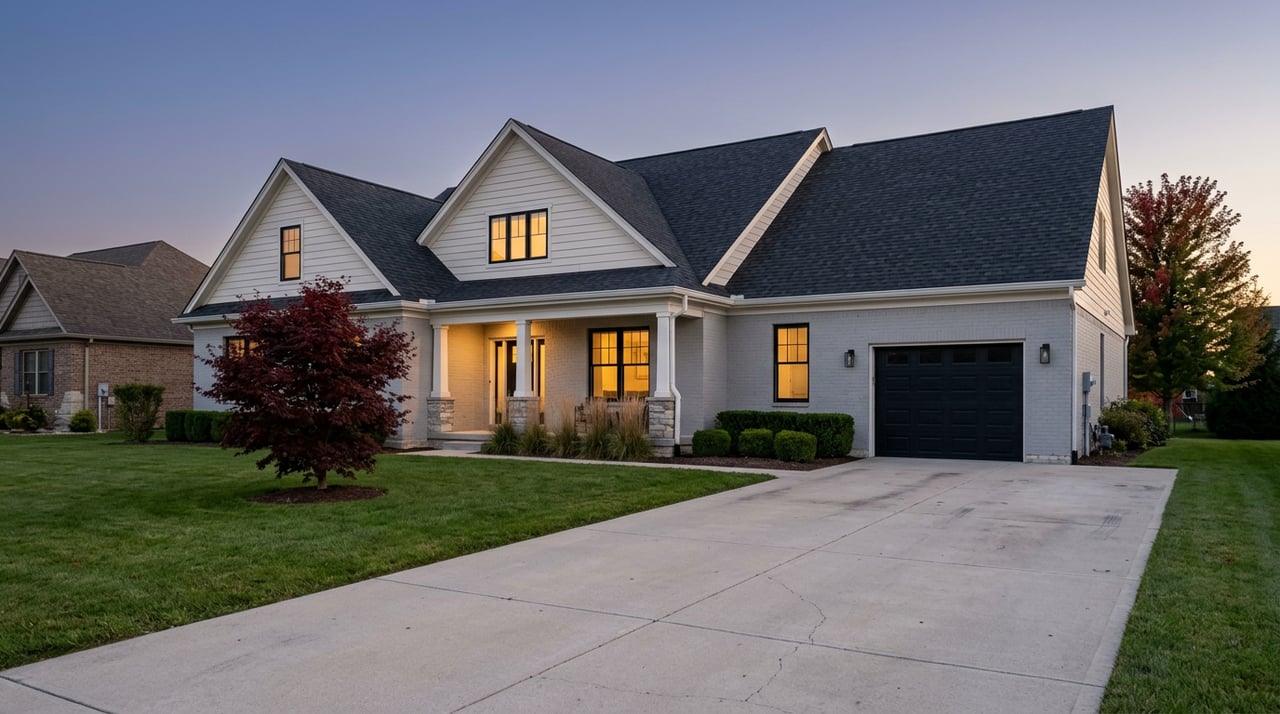
On August 23, an open house ran at a four-year-old D.R. Horton home built on the Holcombe floor plan, four bedrooms, a first-floor office, a full basement with a bath rough-in ready to finish. The listing leads with an assumable FHA loan at 5.25 percent, a detail that only matters because current rates sit well above it. That's a builder-era home competing on financing terms, not on scarcity.
A few streets over, M/I Homes is selling new construction at 328 Merion Drive: a two-story, 1,711-square-foot home with three bedrooms and two and a half baths, part of the same wave of production that's kept builders like D.R. Horton active in communities named Chestnut Commons and Scioto Crossing, and kept Rockford Homes building out Foxfire, a community positioned next to The Players Club at Foxfire golf course. These aren't hypothetical developments. They're active, named, and selling.
What isn't moving at the same pace is the resale side of the market, the homes owned by families who bought five or ten years ago and are now trying to sell into a village that's supposedly on the verge of a boom. Those homes are the ones sitting 141 days. The new-construction pipeline is where the incentives and the urgency live. The existing housing stock hasn't caught up.
Why the Timelines Don't Match
Here's the part that doesn't make it into the press releases: Anduril's hiring plan runs through 2035. The 4,000-job figure state officials cite is a nine-year build, not a hiring event. Ohio's own economic development materials describe it as the largest single job-creation and payroll project in state history, which is true, and also easy to misread as something that happens all at once. It doesn't. A defense manufacturer scaling from a few hundred workers on a production line to four thousand does that in stages, tied to contracts, aircraft programs, and workforce pipelines the company is still building with local technical colleges.
Housing markets, by contrast, reprice in real time based on who's actually looking to buy this month. Right now, the buyers showing up in Commercial Point are largely the ones drawn by new-construction incentives and assumable financing, not by Arsenal-1 job offers, because most of those jobs don't exist yet. The industrial side of the village, including the roughly 900 acres of shovel-ready ground marketed as the Rickenbacker Exchange industrial park and a logistics park Scannell Properties broke ground on this summer, is filling up faster than the workforce that will eventually live near it.
That mismatch is the whole story. The project is real. The jobs are real, or will be. The housing market just hasn't been asked to reflect either one yet, because the people who'll fill those jobs mostly haven't moved here.
What the Numbers Actually Show, Side by Side
| Signal | What it shows |
|---|---|
| Average days on market, 3 months ending April 2026 | 141 days, up from 98 a year earlier |
| Average home value, as of June 2026 | Up 2.9% year over year |
| Median sale price, 3 months ending April 2026 | Up 3.8% year over year, but market activity described as not very competitive |
| Village population | Grew from 3,078 residents in 2020 to roughly 3,305 in 2026, about 1% a year |
| Anduril hiring timeline | Ramps to 4,000-plus jobs by 2035, not immediately |
Read across that table and the picture isn't a village bracing for a gold rush. It's one growing at a steady, unremarkable clip while a nine-figure industrial project builds out next door on its own separate clock. Commercial Point has in fact been described as the fastest-growing village in Pickaway County, which is true and also modest in absolute terms. A one percent annual population gain is real growth. It is not the kind of number that explains a factory this size.
What This Means If You're Buying
If you're looking at Commercial Point because you've read about Arsenal-1 and assume the housing market must already be pricing in the jobs coming, the data says otherwise, and that's useful information rather than a warning sign. A resale market with days on market climbing and a below-average competitiveness score is a market where buyers still have room to negotiate, ask for inspection contingencies, and take their time on a decision, even in a village sitting next to one of the largest industrial announcements in the state's history.
New construction is a separate conversation. Builders are pricing communities like Chestnut Commons, Scioto Crossing, and Foxfire for buyers today, which means incentives, financing terms like the assumable rate on that D.R. Horton listing, and design choices are all things worth comparing against what a similarly priced resale home offers a few streets away. Teays Valley Local School District serves the village, and that's one constant whether you buy new or existing.
What This Means If You're Selling
If you own a resale home in Commercial Point and you're pricing it as though the Anduril announcement already changed what buyers will pay, the current data doesn't support that yet. Days on market more than 40 percent longer than a year ago means overpricing against a new-construction competitor with financing incentives is a real risk, not a hypothetical one. Buyers comparing your home against a builder listing with an assumable 5.25 percent rate are doing real math, and a resale price that assumes future job growth is already baked in will sit.
The upside is real too. A steadily growing village next to a project of this scale is not a bad place to own property. It's a place where patience on the timeline and discipline on the number matter more than confidence in the headline.
A Few Direct Questions
Does the Anduril project mean home values in Commercial Point are about to jump? Not on the timeline most people assume. The hiring plan runs to 2035, and the housing data through spring 2026 shows a slower resale market than a year earlier, not a faster one. Values may move as hiring ramps, but the current numbers don't show that happening yet.
Why are homes taking longer to sell if the area is supposedly growing? Because population growth and industrial announcements don't automatically translate into buyer demand for existing homes. The buyers active in the village right now are largely choosing new construction, drawn by builder incentives, which pulls attention away from resale listings.
Is now a good time to buy in Commercial Point, or should I wait for the market to catch up to the job numbers? That depends on your timeline and what you're comparing against. A resale market with 141 days on market and a below-average competitiveness score gives buyers negotiating room today that may not exist once hiring at Arsenal-1 picks up. Waiting for certainty means waiting past the window where that room exists.
Commercial Point's housing market and its industrial pipeline are running on two different clocks right now, and that gap won't stay this wide forever. If you're trying to figure out what it actually means for your timeline, whether you're comparing a resale home against new construction or deciding when to list, Jordan Silcott can walk through the specific numbers with you. Let's Connect.